
Posted by molly mutt europe on 18.06.26
Dog bed size guide: how to pick the right size every time
Most dog bed size guides focus on one thing: length and width compared to your dog's measurements. That's a reasonable starting point, but it misses most of what actually determines whether your dog sleeps well on a bed or just sleeps near it.
Size matters. But shape, sleeping style, and what's inside the bed matter just as much — and they're rarely covered properly.
Let's start with... how your dog actually sleeps
Before thinking about dimensions, watch your dog sleep for a few days/nights. Most dogs fall into one of two broad categories, and it changes everything about what bed will actually suit them.
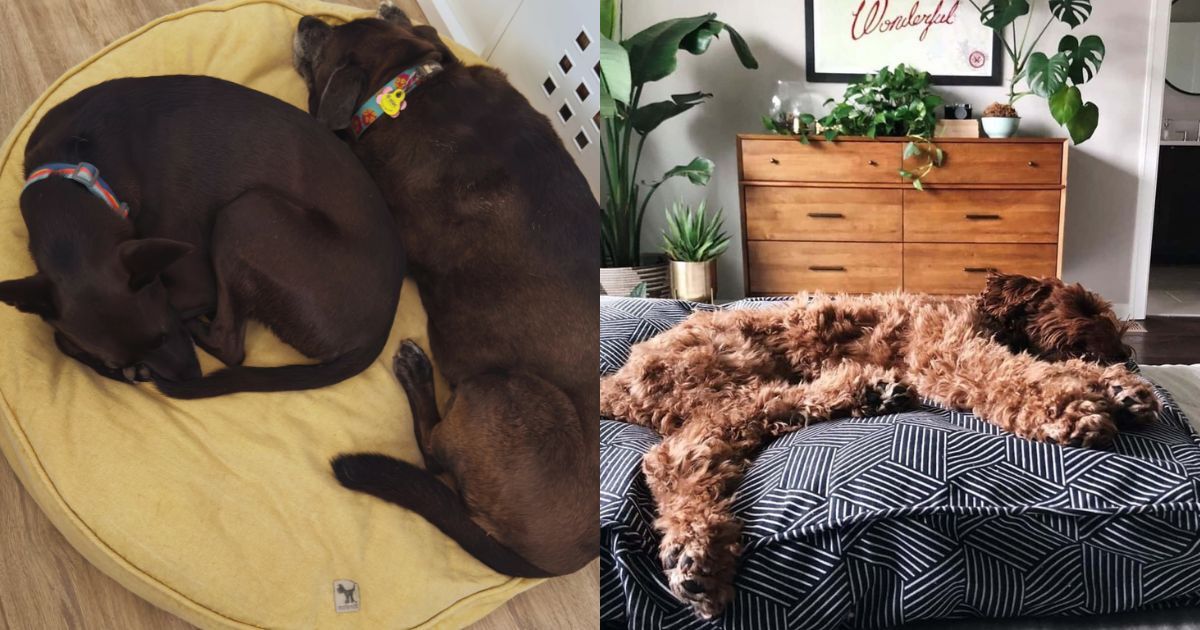
The curler. Nose tucked near the tail, legs pulled in tight, body forming a circle or "donut" shape. This is an instinctive position — it conserves body heat and protects vital organs, a habit inherited from wild canine ancestors who slept exposed to the elements. Smaller dogs and short-coated breeds tend to curl more often, partly because they lose heat faster and the tucked position helps retain it.
The sprawler. Side fully extended, legs stretched out, sometimes flat on the belly with front and back legs reaching in opposite directions (the "superman" pose). This position signals a dog who feels safe, relaxed, and isn't trying to conserve warmth. Larger breeds and dogs prone to overheating sprawl more often, since stretching out helps release body heat.
Many dogs do both, depending on the weather, the time of day, or how they're feeling. But most have a clear default — and that default should guide your choice of bed shape, not just size.
Round or rectangular: which shape actually fits?
This is the question most size guides skip entirely, and it matters more than an extra few centimetres of length.
Round or bolstered beds suit curlers. The enclosed shape gives a sense of security that flat rectangular surfaces don't — it mimics the den-like feeling many dogs instinctively seek, particularly smaller breeds, anxious dogs, and those who simply run cold. The raised edges double as a headrest, which most curlers use without you ever noticing.
Rectangular beds suit sprawlers. A flat, edge-free surface lets a dog fully extend without bumping into bolsters or feeling boxed in. This is particularly important for larger breeds and dogs with joint stiffness, who need to stretch out fully to stay comfortable rather than being forced into a curled position that puts pressure on hips and elbows.
If your dog regularly does both — curls in the evening, sprawls after a walk — a slightly oversized rectangular cover is usually the more flexible choice. It gives a sprawler full room and still allows a curler to claim a corner of the same space.
What this means for your home, not just your dog
Shape isn't only about your dog's comfort — it also has to work in your space.
Rectangular covers fit naturally against walls, under furniture, or into corners. They make better use of awkward room shapes and tend to look intentional rather than like an extra object dropped into the middle of a room. For smaller flats or multi-purpose rooms, this matters more than people expect.
Round covers work well as a standalone feature — in the centre of a room, beside a sofa, or in open-plan spaces where there's no specific corner to fill. They don't tuck into edges as easily, but they read as more deliberate, almost like a piece of furniture rather than equipment.
If you live in a smaller home or want the bed to disappear into the room rather than dominate it, rectangular is usually the more practical choice. If you have an open space and want the bed to be a visible, designed part of the room, round works well.
Getting the size right
Once you know the shape, size becomes simpler. The standard method: measure your dog from nose to the base of the tail while they're lying down in their natural sleeping position, then add 15 to 25cm.
For sprawlers, measure them fully extended — not curled — to capture the space they actually need. For curlers, measuring in their tucked position is more accurate, though it's still worth adding a few extra centimetres so they're not wedged in.
A common mistake is sizing for a puppy's current size rather than their adult size. If you're buying for a growing dog, size up — a slightly oversized bed now is far cheaper than replacing it in six months.
If your dog ever hangs off the edge, circles repeatedly without settling, or keeps shifting position and getting up, the bed is too small. That restlessness is usually a sizing problem, not a behavioural one.
Filled or empty: why this matters as much as size
Most beds on the market come pre-filled with foam or synthetic fibre, sealed inside a cover you can't access. This works, but it has two real downsides: you can't control the fill, and you can't wash it properly.
Pre-filled natural beds — filled with genuinely natural materials like organic cotton or wool — are a reasonable option if you want something ready to use straight away. But many "natural fill" claims are vague, and as we covered in our piece on greenwashing in pet products, "natural" on a label doesn't always mean what it implies.
The alternative is a fillable cover — a shell you stuff yourself, typically with old clothes, blankets, or towels you already have. This has three advantages pre-filled beds can't match: you control exactly what's inside, you can wash the cover properly because the filling is separate, and the filling already carries your scent, which is one of the strongest comfort signals a dog can have (read the science behind it in our article on why your scent matters to your dog).
A fillable cover sized correctly for a curler can be packed densely in the centre, creating a natural nest shape without needing a structured bolster. For a sprawler, a looser, more evenly distributed fill across a rectangular cover gives the flat surface they need to stretch out properly.
What if you have two dogs (or two cats or one dog and one cat or...)?
This depends entirely on how they relate to each other, not just their combined size.
If they already sleep touching each other — piled together, back to back, or draped over one another — a single larger bed (provided the house has enough space) usually works well and reflects how they already choose to rest. Add roughly 50% more surface area than you'd give a single dog of the same combined size, since pets sleeping together don't need as much individual space as they would separately.
If they maintain distance from each other even when resting in the same room, two separate beds are the better choice. Forcing two dogs who value their own space onto one bed can create low-level tension that shows up as restlessness, resource guarding, or one dog simply avoiding the bed altogether.
If you're unsure which applies, start with two separate beds placed near each other. Dogs that want to share will often end up doing so anyway, dragging one bed closer or piling into one over time. It's easier to merge two beds into a shared routine than to separate one bed into a conflict.
The same logic applies to cats, with one difference: cats are generally more territorial about sleeping space than dogs, even cats who get along well. Two separate beds is usually the safer default for multi-cat households, even when the cats are affectionate with each other while awake.
In a nutshell
- Watch how your dog sleeps before buying anything — curler or sprawler is the most important decision, more than exact dimensions
- Round and bolstered shapes suit curlers; flat rectangular shapes suit sprawlers
- Consider your room shape too — rectangular fits corners and small spaces, round works as a standalone feature
- Measure in your dog's natural sleeping position and add 15–25cm
- A fillable cover gives you control over what's inside and lets you wash it properly — something pre-filled beds can't offer
- For multiple pets, follow how they already choose to rest together, not just their combined size
No single bed shape or size is right for every dog. But matching the bed to how your dog actually sleeps — rather than just their measurements — is the difference between a bed they tolerate and one they choose.