
Posted by molly mutt europe on 27.05.26
Why your scent matters to your dog: the science behind it
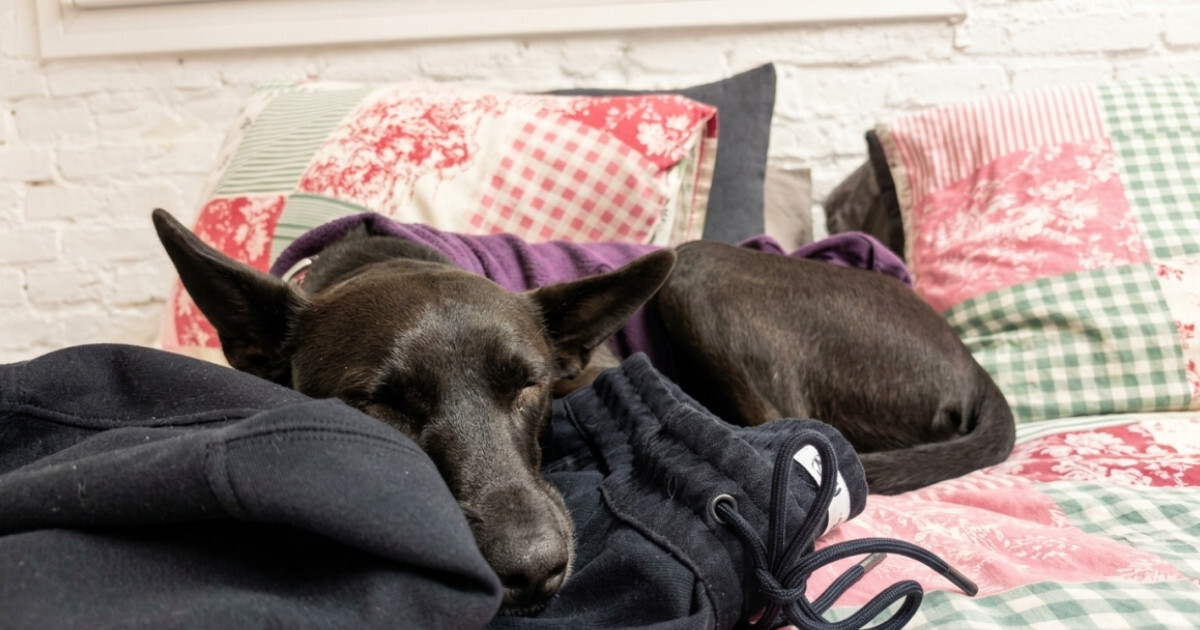
You've probably noticed it. You leave a jumper on the sofa and your dog is on it within minutes. You come home after a long day and they press their nose into your leg before they even look at you. You wash their bed or blanket and somehow they seem less comfortable with it for a few days.
None of this is random. It's your dog's nose doing exactly what it is supposed — and evolved — to do.
How your dog's nose actually works
A human nose contains roughly 6 million olfactory receptors. A dog's nose contains between 100 and 300 million, depending on the breed, or the "mix". That's not just a much bigger version of what we have — it's a fundamentally different way of experiencing the world.
Think about when you walk into a room and notice the coffee smell. Your dog notices the coffee, who made it, how long ago, what else that person touched that morning, and whether anything in the room has changed since yesterday.
Dogs also have a second olfactory system that humans lack entirely: the vomeronasal organ, or Jacobson's organ, located at the roof of their mouth. This processes chemical signals — pheromones and other scent information — that bypass conscious awareness altogether. It's the part of the brain that reads emotional states, familiarity, and safety directly from smell alone.
In short: your dog doesn't just smell you. They read you entirely, and the spaces around.
What your scent means to them
For a dog, familiar scent is one of the primary signals that they are safe.
In pack animals, the scent of the group is a constant background presence — it marks territory, confirms belonging, and reduces anxiety. For a domestic dog, you are the pack. Your scent is what home smells like at a neurological level.
A 2016 study published in the Journal of Veterinary Science tested 28 dogs with separation anxiety, dividing them into three groups — one left alone, one left with their owner's worn clothing, one played a recording of their owner's voice. The dogs left with the owner's clothing showed significantly lower cortisol levels during separation than the control group. Heart rate drops. Dogs settle faster and sleep more deeply.
This isn't the dog being sentimental. It's a hardwired response to a chemical signal that says: this place is safe, my people have been here, I can rest.
Why your dog steals your clothes (and why you should let them)
The clothes you've worn carry the richest concentration of your scent — specifically, the sebaceous glands in your skin produce a chemical signature that is unique to you and remarkably stable over time. Worn fabric absorbs and holds this signature for days.
When your dog drags your hoodie off the bed, digs through the laundry basket, or refuses to leave the pile of clothes you left on the floor, they are not misbehaving. They are seeking comfort using the most reliable tool available to them.
It's worth noting this behaviour tends to increase when dogs are anxious, when routines change, or when you've been away longer than usual. The scent-seeking is self-regulating — a way of managing emotional state without any input from you.
Are cats also relying on scents?
Cats are often described as less scent-dependent than dogs, and in some ways that's true — they rely more on visual territory markers and don't have the same pack-bonding instincts. But the picture is more nuanced than "cats don't care about smell."
Cats have around 200 million scent receptors — fewer than most dogs, but still roughly 40 times more than humans. They also have the vomeronasal organ. And any cat owner who has watched their cat knead and settle into a worn jumper knows there is something special happening there.
In fact, another study published in May 2025 by researchers at Tokyo University of Agriculture found that cats spend significantly longer sniffing a stranger's scent than their owner's — evidence that they actively recognise us by smell alone, even without visual or auditory cues.
What cats respond to when it comes to familiar scent is slightly different from dogs. Rather than the pack safety signal, it's more about territory and comfort association — the scent of their environment, including the humans in it, signals that this is their space and that nothing has changed. Cats are territorial creatures of controlled routine, and familiar smell is part of that control.
The behaviour of lying on your clothes, sleeping on your pillow, or pressing their face into the crook of your arm — these are not random affections. When a cat bumps their head against you or rubs their cheek along a table leg, they are doing something specific: depositing scent from the glands around their face in a behaviour known as bunting. They are marking you, and the objects around them, as part of their world. Sniffing tells them you belong here. Bunting tells you — and everything else — that they've decided so.
The reason why we created a dog bed cover
Here's the practical conclusion of all of this: the best bed for your dog or cat is not necessarily the most expensive one, the most padded one, or the one with the highest thread count.
It's the one that smells like you.
This is why a Molly Mutt bed cover works the way it does. The cover is a shell — you fill it yourself, using old clothes, worn blankets, jumpers that have seen better days. Everything that was heading for the donation bag. The bed your pet sleeps on is made entirely from textiles that already carry your smell, your home, your daily life.
It isn't a marketing angle. It's just what happens when the filling comes from your wardrobe rather than a factory. And the added value — not a small one — is that those old clothes, blankets and pillows stay out of landfill. Better for your dog. Better for the planet.
Want to build one?
If you've never tried filling a bed with your own clothes, it takes about ten minutes and costs nothing beyond the cover itself. You pack it, your dog (or cat) investigates it, and within a day or two they've claimed it completely.
Any size, any print. Machine washable cover, filled with whatever you already have at home.
Sources
- Berns, G. et al. (2022). Extensive Connections of the Canine Olfactory Pathway Revealed by Tractography and Dissection. Journal of Neuroscience. jneurosci.org
- Kolasa, M. et al. (2026). The Role of Olfaction in Dogs: Evolution, Biology, and Human-Oriented Work. MDPI Animals. mdpi.com
- Stress, Security, and Scent: The influence of chemical signals on the social lives of domestic cats and dogs. Applied Animal Behaviour Science. sciencedirect.com
- Shin, Y.J. & Shin, N.S. (2016). Evaluation of effects of olfactory and auditory stimulation on separation anxiety by salivary cortisol measurement in dogs. Journal of Veterinary Science. pmc.ncbi.nlm.nih.gov
- The effect of owner presence and scent on stress resilience in cats. Applied Animal Behaviour Science (2021). sciencedirect.com
- Miyairi, Y. et al. (2025). Behavioral responses of domestic cats to human odor. PLOS One. journals.plos.org